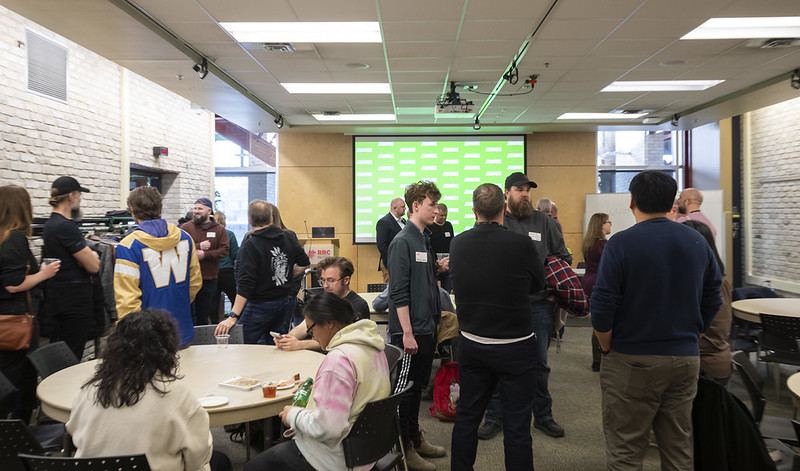
At WABE’s fourth annual Media Meetup in Winnipeg, 47 people gathered at RRC Polytech, thanks to our sponsors, Erickson Pro, Erickson Commercial, DEMA, and Matrix Video.
In attendance were local folks involved with media and entertainment technology from the film community, New Media Manitoba, University of Manitoba, Winnipeg Blue Bombers, True North Sports & Entertainment, Bell, Rogers, Pattison Media, and Golden West Broadcasting, alongside freelancers, broadcast retirees, and many familiar faces from across Manitoba’s media landscape.
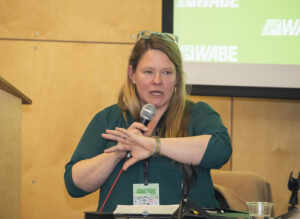
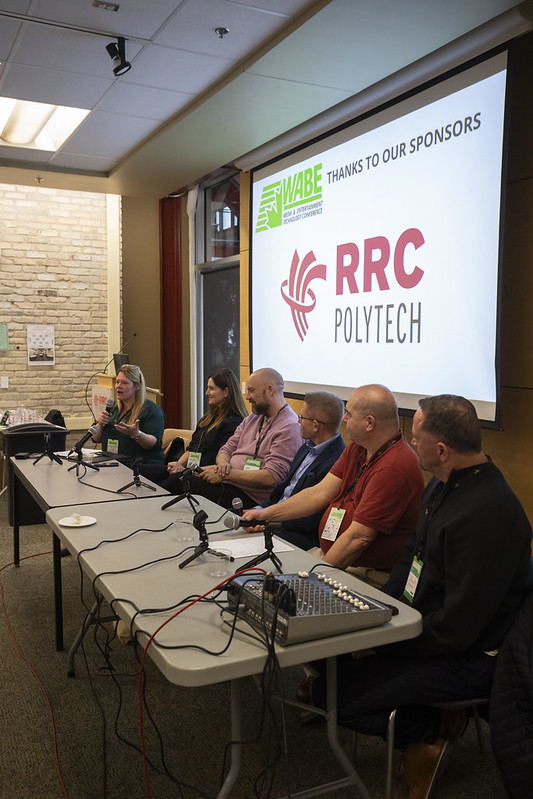 The topic of how media jobs are changing gave panellists Janice Labossiere, Media Production Services at U of M; Lesley Klassen, Senior Manager AI Initiatives & Services at New Media Manitoba; Dave Lehman, Chief Technology Officer at Golden West; Rob Brown, Broadcast Technician at Pattison Media; and Ken Gould, Director, Strategic Sales at APPEAR, a chance to talk about their careers, experiences with AI, and the skills they feel will be essential moving forward, not just for students, but for career professionals already working in the industry.
For those of us working behind the scenes in media, one of the biggest themes wasn’t a surprise: curiosity. If you aren’t a lifelong learner, this industry can be difficult to keep up with. Figuring out how things work, adapting to new tools, and learning how to work alongside AI are already skills many people in broadcast engineering have in spades.
One of the things I realized while working the room at the meetup, introducing myself to as many new faces as possible and giving hugs to familiar friends in the industry, is that sometimes we undercut what we actually know in broadcasting. So much of the technology being used right now to create and deliver content was foundationally built in the broadcast engineering space. Encoding, multiplexing, videographics, all of these core pieces started a really long time ago and were developed by innovative companies, inspirational engineers, and tech-savvy developers.
 In Canada alone, the amount of media tech developed in garages, basements, and small businesses is worth 10 articles on its own. That’s why these cross-sector gatherings matter. In my opinion, gatherings like the WABE Media & Entertainment Technology Conference are more important in Canada now than ever before. Nothing is static. The past is the past. The future is coming, and there are still ideas sitting on the table waiting for the right people to connect.
The biggest lesson this meetup in Winnipeg taught me was that it only takes one handshake and one conversation to discover something cross-sector that has real potential.
My moment came when I shook hands with someone who runs a post-production facility in Vancouver, moved to Winnipeg because he likes it here, and is now opening a studio servicing special effects and video game manufacturers. We started talking about life, production, and the differences between our worlds. In his industry, they create entire environments using VR walls, Unreal Engine, and software tools that build completely new worlds.
Where their experience is limited is in live production. And suddenly the conversation became exciting.
 Can you imagine a world where there’s a live event at 5 p.m. inside a video game? Fortnite has begun making this a regular attraction. What if a special guest appeared live in the game world itself? What if you moved beyond Keanu Reeves simply being written into Cyberpunk 2077 as a voice-tracked character, and instead had him hosting with a live band performance inside the game during launch night? You only need to check out this list of celebrities appearing in Fortnite to see where the convergence in creative is already overlapping movies and TV. What happens when those worlds stop being static and become live experiences?
That’s where innovation lives, in conversations between sectors that traditionally didn’t overlap.
This is where I think broadcasting sometimes undersells itself. While the gaming world is hiring celebrities and experimenting with immersive worlds, broadcasters and production companies already understand live. They understand timing, latency, audience engagement, signal flow, monetization, sponsorship, storytelling, reliability, and the power of what happens when thousands or millions of people all tune in at once. Sometimes we speak about video game integration as if it simply means broadcasting esports tournaments, but the bigger opportunity is realizing the technology and production experience we’ve already built over decades can shape entirely new forms of entertainment.
 If, in the next two years, you have a way to connect with people live and can’t figure out how to create value or build a business around it in Canada, it can’t be only regulation holding you back. Creativity and trying new things was always key in media, or possibly, you are waiting for someone somewhere else in the world to tell us where the next opportunity is going to come from.
The fundamentals, though, don’t change. After 25 years in this industry, I feel I still have the skills to remain curious, keep learning, and continue adapting, even though nothing today looks like it did when my career started. What many of our panels talked about repeatedly is that the core skills remain incredibly valuable: troubleshooting, learning the fundamentals of the sciences behind tech, understanding the business you’re trying to support, and then finding the tools, technology, partners, or innovations that create the next audience experience, the next storytelling method, or the next way sponsors connect their brands to people.
The great thing about holding the event at RRC Polytech was seeing staff, students, and working professionals all in the same room. It reminded people that there are still careers, jobs, and opportunities in media and entertainment, even as business models and platforms evolve. Rights holders are moving from traditional to digital platforms, companies are being bought and sold, and startups are constantly appearing, but behind the scenes it is still people creating stories, building experiences, and delivering content.
I can attest to this myself from this past season of NHL hockey, where the Amazon Prime Video crew rolled up in a Dome Productions truck wrapped in Amazon graphics and filled with many of the same people I’ve worked with before in sports production. The platforms evolve, the audience delivery method is newer, but the people and skillsets behind them are the same.
 The event also brought students who stayed right until the end to connect with industry professionals. One was hoping for a summer job while taking electronic engineering and was fascinated by the audio mixer splitting microphones for the panel. Another was a high school student passionate about live production technology who teaches others at his school how the systems work for their drama productions and is now entering engineering at U of M.
Both were bright eyed, curious, energetic, and exactly the kind of people this industry needs. That night, the world opened up a little wider for them, realizing there are careers built around creativity, storytelling, technology, troubleshooting, and innovation.
Another major topic during the discussion was the use of AI to build tools. Most of the panellists talked about using AI to improve efficiency, expand ideas, research products, and even build private tools for themselves or their businesses. Lesley Klassen gave an example of creating an application that lets you scan a room with your phone and determine what camera lens or CMOS [Complementary Metal-Oxide Semiconductor] sensor might work best for the environment. Anyone who has arrived on site only to realize they brought the wrong focal length immediately understands the value of a tool like that.
AI platforms like Claude and ChatGPT are already helping professionals sift through manuals, product specs, and technical documentation faster. But beneath all of that technology, the fundamentals still matter, storytelling, communication, critical thinking, electronics theory, physics, audio, visuals, and the ability to work with other people.
It’s also important that governments, regulators, broadcasters, creators, and tech companies continue talking about what we are putting out into the public. Canadians still care about truthful information, journalism, storytelling, and Canadian voices being heard. We know unrestricted access to audiences through social media has also brought real harm, misinformation, and difficult conversations about regulation and accountability. But that doesn’t mean innovation should stop. It means we continue building better experiences while understanding the responsibility that comes with reaching audiences.
The on-demand world has incredible value. With modern schedules, multiple time zones, and people working unusual hours, accessibility to content has never been greater. But the power of live still remains, and nobody understands that better than broadcasters, live production crews, and production companies.
I’m happy there’s a radio station playing music while I drive across the country in the summer. I’m happy there is news available on digital platforms while I’m away. I’m happy there are movies, television shows, concerts, plays, livestreams, sports broadcasts, and creators teaching people how to fix their washing machines on the internet.
By the end of my career, I’m looking forward to being able to say I never did the same thing for five years. The endless change taught me endless curiosity and endless learning, and the pride I have in this industry comes from how closely it allowed me to participate in and interact with technology that influenced the entire world.
There’s a reason standards councils, governing bodies, advertising bodies, and oversight organizations exist to understand the technology and help look after the public interest. Because this messy, behind-the-scenes, innovative world of media and entertainment is one even the most invested, curious, and smartest people are grappling with all of the time.
If you’re a media and entertainment leader right now and you do not have your chief technology officer sitting at the table at the same level as HR, sales, and marketing, you are going to miss the next big opportunity. They will help you figure out how to prompt it, how it works, how information is secured, and what happens when we build and use new tools with AI, just like we did when that new technology called the internet first made its way into media and entertainment years ago.
Media and entertainment technology is working behind the scenes, often invisible, but absolutely essential. AI is simply the latest technology in a long line of transformations that started more than a hundred years ago when audio first travelled down a wire and the first electronic video images glowed across phosphors on early television displays.
Just like we had to learn how an audio waveform moved from your mouth to a microphone, down a wire, to be encoded, transmitted, and captured, we are now going to have to learn what role AI plays in making that audio sound better, be delivered faster, or be used to enhance an experience. Innovation, automation, innovation, automation, that has always been the cycle of the technology behind media and entertainment.
You can either fear change or be curious and embrace it.
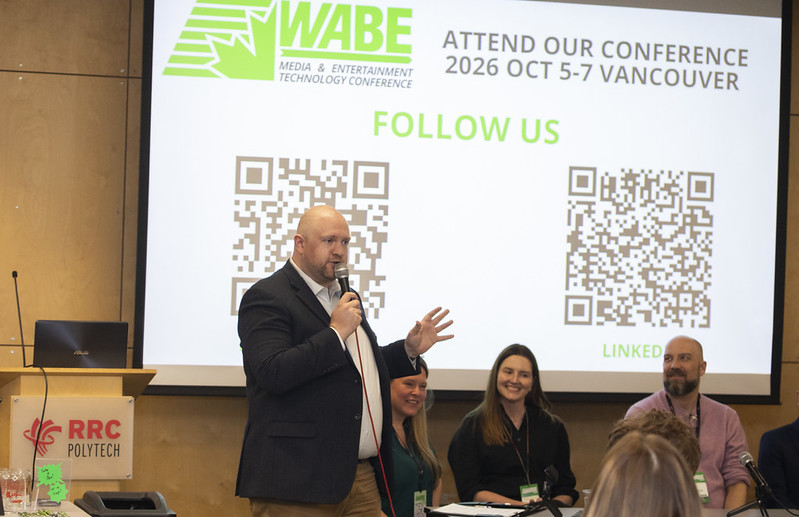
That’s why you need to support, sign up, exhibit, and come to the WABE Media & Entertainment Technology Conference in Vancouver this year. Your next conversation may be the next innovation.