Media marketing organization thinktv says new Ipsos research highlights the ongoing gap between how Canadians use and perceive media and how ad industry professionals do.
The fourth edition of the thinktv / Ipsos Ad Nation report suggests assumptions about consumer behaviour continue to be influenced by the industry’s own media habits, highlighting a persistent divide between how marketers believe Canadians consume media and what everyday households report doing.
TikTok is cited as the clearest example, which was reportedly used by 30% of Canadians in the past month. Industry professionals estimated that percentage at 89% — a 59 percentage point gap. The report found similar patterns across streaming services, digital platforms, and artificial intelligence tools.
Researchers attribute this disconnect to “projection bias,” where agency planners and brand marketers project their personal digital habits onto the broader public. Industry respondents are far more likely to own streaming hardware, subscribe to digital services, and early-adopt emerging tech like artificial intelligence tools compared to the average consumer.
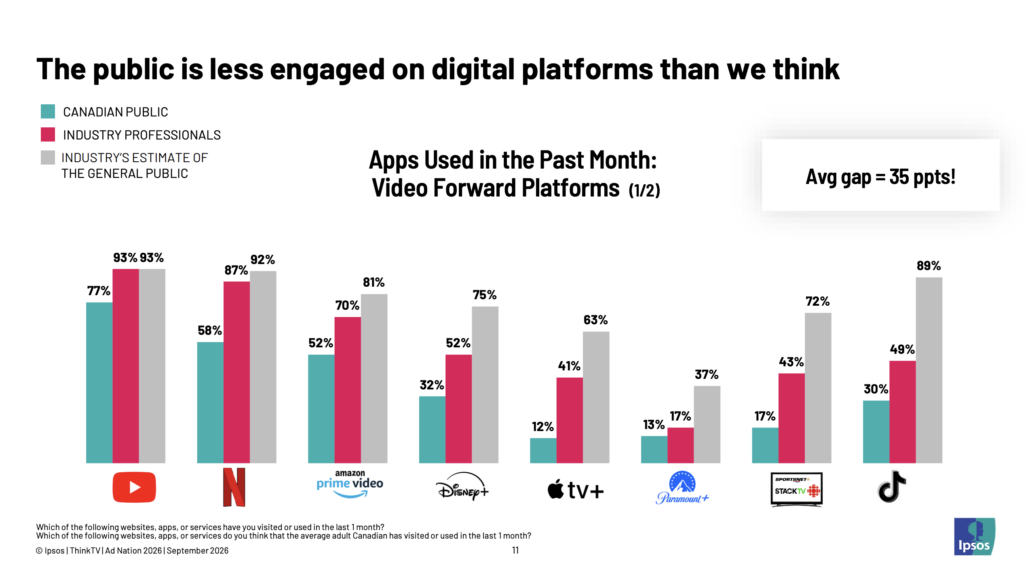
Ipsos maintains that the Canadian public is less engaged on social and digital platforms than the ad industry thinks. While Spotify, for example, is used by 40% of the public and 69% of those working in the industry, marketers estimate public usage at 88%. Those projections, according to the report, result in an average gap of 35 points between actual usage and reality across digital platforms.
The report found that gap also extends to use of AI tools, with 84% of industry professionals using AI in past month, in line with their projections (86%) of public usage. In reality, 29% of Canadians have used an AI tool in the past month, according to Ipsos’ research.
The report’s findings also reveal however that marketers over-estimated daily usage of traditional television. Industry estimates of 1.8 mean hours a day are slightly above the actual 1.1 hour average consumed by the public. When it came to projecting radio usage, marketers accurately estimated average listening at 1.2 hours per day.