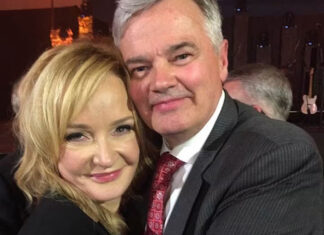
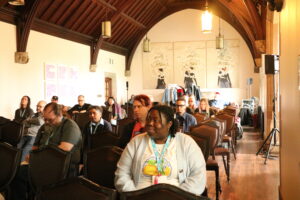
Canadaland founder and publisher Jesse Brown laid out a monetization road map for podcasters at the first-ever Podcast Day for Creators on the University of Toronto campus during Radiodays North America last week.
Brown told the room that Canadaland’s “playbook” for turning 10,000 listeners into one of the most successful podcasting networks in the country is more relevant than ever as the “dumb money” and venture capital bubbles in podcasting continue to burst. His model for financial independence is built on a 10% conversion rate to turn listeners into paid subscribers.
“You can build the audience first to a point where—and I think 10,000 is a really good number—and then the average amount of monthly…shoot for a one-in-10 conversion rate,” explained Brown. “So, that means I have 10,000 people…I wanted 1,000 to give me $5 a month. That’s $5,000 a month, that’s $60,000 a year. That’s pretty much what I was making as a freelancer…it happened so quickly. I was terrified it wouldn’t happen at all”
While initially “bashful” and “embarrassed” to ask listeners for money, Brown said he quickly became shameless.
“I quickly got over that. I’m very shameless about it now,” he said, adding that it’s integral to “deputize” the audience into helping get something in return.
“Like, we’re gonna build this thing together, and it’s gonna get bigger and stronger…and then it’s like an organic thing where it grows to the size, naturally, that people want it to be. So it was always this conditional thing. Like, if you want me to expand and hire a reporter, this is the goal. If you want this to be not just a show, but a network, and we’ll do a politics show, here’s that goal.”
 He also told creators that if you want a funding model to work, the stakes must be real, noting that during his first crowdfunding campaign, he told his audience that if they didn’t hit their target, Canadaland would cease to exist.
“I remember saying, like, ‘I love doing this. I want to do my job, but I can’t do it for free.’ And I decided, no, I have to be willing to kill us…like, ‘pay or the puppy will die,’ kind of,” joked Brown. “Like, it has to be real. And then I was prepared to stop if we didn’t hit the first goal.”
He acknowledged that Canadaland’s launch came before the average person had “umpteen” digital subscriptions, which presents a different problem.
“You’re competing with everyone from, you know, Netflix, to creators that people support. I do think that podcasting remains the best medium format for sustained monthly revenue, because even when people fall in love with an influencer or a creator, those relationships go through so many ups and downs…do you really want to spend 30 minutes with that person every week?”
Finding a ‘passionate niche’
In a world with millions of podcasts, Brown also warned against the “general interest” trap. He noted that many creators shoot themselves in the foot by launching shows about “me and my friends hanging out” or “movies.”
“I, by accident, found myself appealing to a passionate niche,” he said of Canadaland’s media-criticism focus. “You want an audience that you’re going to be able to turn to and say, ‘If I don’t do this every week, no one’s going to do it.’ You want people who have a pre-existing hunger…to be seen, to be reflected.”
Weathering the ‘audience capture’ storm
Brown acknowledged that Canadaland subscriptions took a hit in 2023, following the October 7th attacks in the Gaza Strip and the significant backlash that followed in what was perceived as a “pro-Israel” stance and subsequent coverage focus on the Anti-Zionism movement and rise of anti-Semitism in Canada. At its peak, that backlash cost the network roughly 15% of its subscribers.
“We went through an audience capture crisis,” Brown admitted. “It was a little bit of an organic cancellation campaign…people were saying ‘anyone still supporting this is supporting a genocide.'”
However, he refused to accept the terms that ceasing their coverage because some listeners didn’t like it was a good business decision.
 “I always knew that we would have to be willing to keep covering something, even if it costs us subscribers, while remaining accountable and transparent,” he told the audience. “And you don’t know when you’re losing dozens or hundreds of people, where’s it gonna stop? It stopped at about 15%. Which is a lot, you know, that’s more than a year’s work of growth for us. And then we saw a little bit of a lift, as people who were glad that I was saying these things came in.”
Brown said what was encouraging was the 85% of the audience that stuck around, not necessarily because they agreed with him.
“A lot of them still disagree with me. But I found that core that I always hoped was the audience we built. The people who are okay with disagreeing, are okay having their opinions challenged…’I don’t like this guy, what he’s saying, but…I like this exists,'” he added, noting that Canadaland has since turned a corner and returned to “pre-crisis levels of supporters.”
Video podcast skeptic
When asked about the industry-wide push toward video, Brown remains wary, describing video production as a “labour-intensive, distinct form of media” that often drains budgets away from the core audio product.
“When I open Apple Podcasts, I’m driving my car or doing the dishes. I don’t want to watch a video,” Brown said. While he acknowledged that a younger generation views YouTube as the primary home for podcasts, he cautioned against simply “throwing cameras in a studio.”
“If you want to succeed in the vibrant video podcasting world, you have to build a show from the ground up to be a video podcast,” he concluded. “I remain leery, but I’m dipping the toe in.”