Neither YouTube nor the major streamers saw an increase in viewer time year-over-year, according to thinkTV’s Fall Total TV & Streaming Viewing report.
Released this week, the report emphasizes what the TV marketing and research association says is the Canadian reality vs. the U.S. narrative, arguing that American data can’t be used as a proxy for Canadian viewing habits.
According to the report, which primarily relies on Numeris’ VAM (Video Audience Measurement) data, streaming in Canada accounts for just 20% of TV set viewing, compared to 50% of viewing on a TV set stateside.
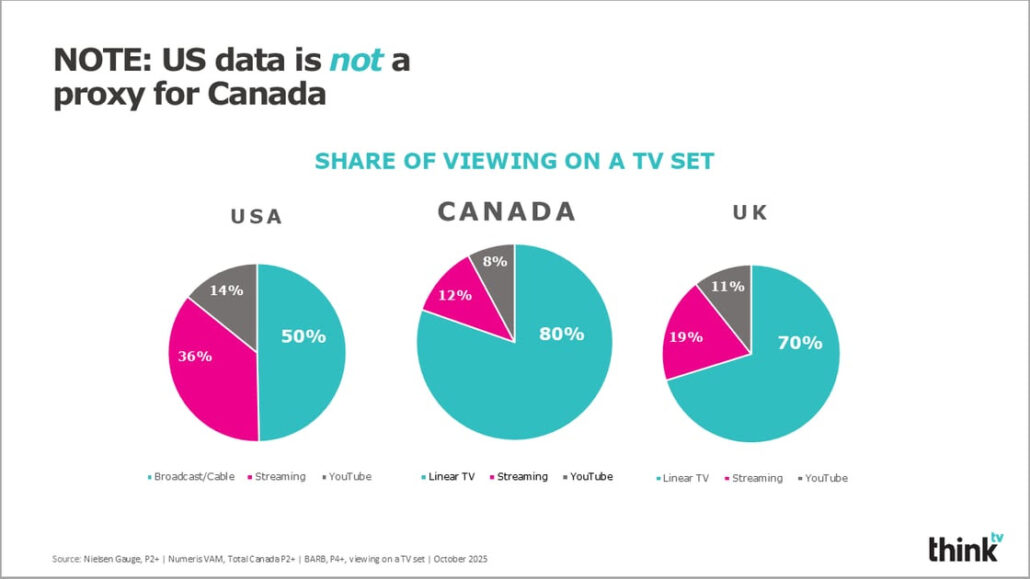
Linear TV dominates in the living room, in particular, accounting for 80% of time spent on a TV set, according to the report. It maintains that TV takes the top spot, even among young adults (A18-34), where it continues to beat YouTube in time spent.
thinkTV says Total TV (which encompasses a combination of traditional, linear television across cable, satellite, and IPTV, in addition to ad-supported broadcaster streaming services like CBC Gem and STACKTV) delivered a massive 82% weekly reach, outperforming YouTube and other premium streaming platforms, commanding a 72% share of all video viewing.
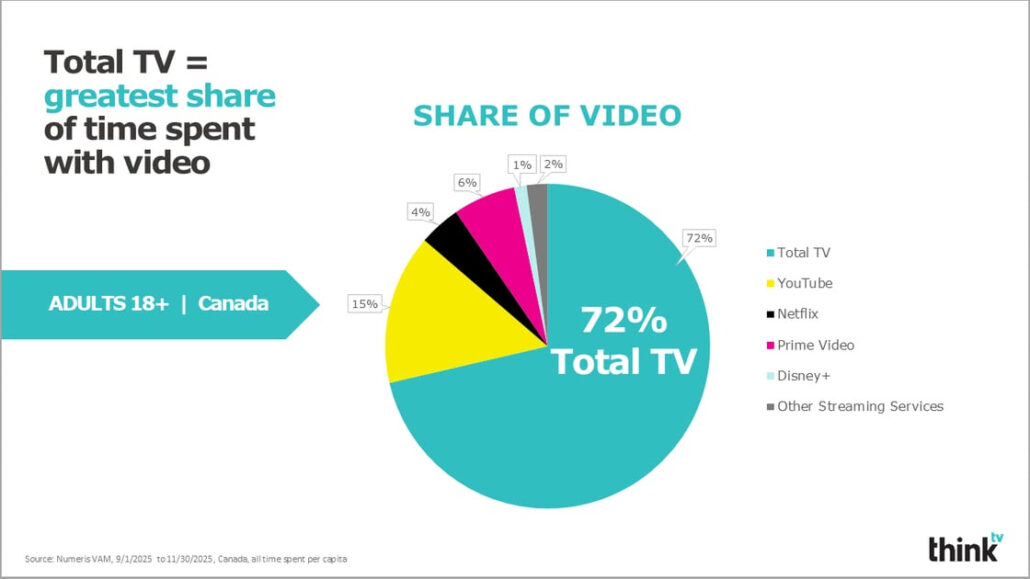
As VAM moves from Ontario reporting only to a national sample, a spokesperson noted some small shifts, but said the overall picture is stable, offering a better representation of true media habits across the country.
Comparing fall 2024 vs. the national sample for fall 2025, thinkTV’s data indicates that switching to a total Canada dataset revealed an increase in TV only viewers across all measured demos – those who only watch TV and don’t use streaming services.
Notably, the 18-34 demo saw an increase in only streamers and only TV viewers. TV’s share of video also increased for both A18+ and A18-34, while YouTube experienced a bump with both the A25-54 and A18-34 demos, both taking share from streamers like Amazon Prime Video and Netflix. Netflix in particular saw a loss in share, year-over-year across all three demos.
In terms of average time spent per week, TV jumped from 15.6 hours to 17.2 hours (A18+). YouTube gained 0.8 hours with the 25-54 demo, but lost 0.1 with the younger demo. By province, Ontario viewers lean slightly more digital than average.