Based on the 2025 Society of Broadcast Engineers (SBE) compensation survey, the numbers confirm what many employers across broadcasting and media operations are already seeing firsthand: the technical workforce is aging, retirements are approaching, and the pool of qualified applicants is getting smaller.
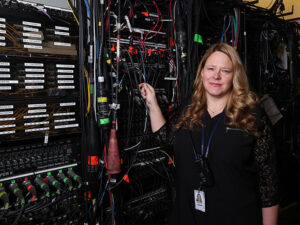
The survey noted that most engineers were between 50 and 70 years old, the single most common age group was engineers in their fifties, many respondents had more than 30 years of experience, and the survey included approximately 270 qualified respondents. That is not just a statistic. It is a very real succession issue for broadcasters, production companies, and media organizations trying to maintain technical continuity in the years ahead.
At the same time, one of the biggest challenges in Canada is that there are very few direct educational pathways that clearly train someone to step straight into a broadcast engineering or broadcast technician role. If your company already has a senior engineer nearing retirement, or you know there is a chance you will need one in the future, waiting for the perfect experienced applicant to appear is no longer a reliable strategy. The better long-term plan is to start building your own pipeline now.
This is not a strategy that solves a staffing shortage tomorrow. It is a strategy that increases the number of viable applicants in the future and gives your organization a better chance of surviving the next wave of retirements.
A strong place to start is by building relationships with local colleges or polytechnics that offer two-year Electronic Engineering Technology programs or similar technical diplomas. Those programs are still producing graduates with useful foundations in electronics, communications, troubleshooting, and systems thinking. Faculty and program coordinators can often point you toward students or recent graduates who stood out in communications systems, completed projects related to audio, video, RF, networking, or control systems, enjoy computer technology, and are the kind of people who like hands-on technical work. Many students simply do not know that broadcast engineering or broadcast technician roles are even a career path. That is part of the problem. The industry has not always done a good job of showing them that these jobs still exist and that they are evolving rather than disappearing.
It is also worth looking beyond electronics programs alone. Networking students and computer engineering students can absolutely be part of the solution, especially as more facilities rely on IP workflows, software-driven control, remote contribution, automation, and hybrid cloud systems. But employers need to be very clear about what the work actually looks like. A broadcast technician is not someone who sits at a desk all day. This is a job that can mean being on ladders, under desks, at the bench, taking things apart and putting them back together, building, repairing, and troubleshooting proprietary systems. Yes, the system may run on software, and yes, networking and computer troubleshooting are now extremely important, but the role is still deeply physical and hands-on.
A broadcast technician may be using a screwdriver, tie-wrapping cables, pulling cable runs, making connectors, mounting hardware, finding practical solutions for cameras, microphones, tripods, and all the bits and pieces that make a production or facility work. They may be plugging systems into mixers, switchers, routers, and intercoms, then tracing signal paths across complex chains of equipment. They need to understand signal flow across dozens of formats and standards, often in environments where legacy and modern systems live side by side. That means the ideal recruit is not just someone who is comfortable with software or IT concepts, but someone who is also mechanically curious, willing to get their hands dirty, and comfortable solving problems in the real world.
That is why creating a junior role on purpose is such an important step. If companies want future engineers, they need to create an entry point. That role might be called Junior Broadcast Technician, Junior Media Systems Technician, Broadcast Operations Technician, or Junior Technical Support for Media Systems. It could be part-time, contract-to-hire, or full-time, but it needs to be designed as a developmental position rather than a desperate attempt to hire someone who can already do everything. Ideally, it should pay above minimum wage, with at least a reasonable starting point for the market, and with a clear understanding that the role is a training pathway rather than a finished product.
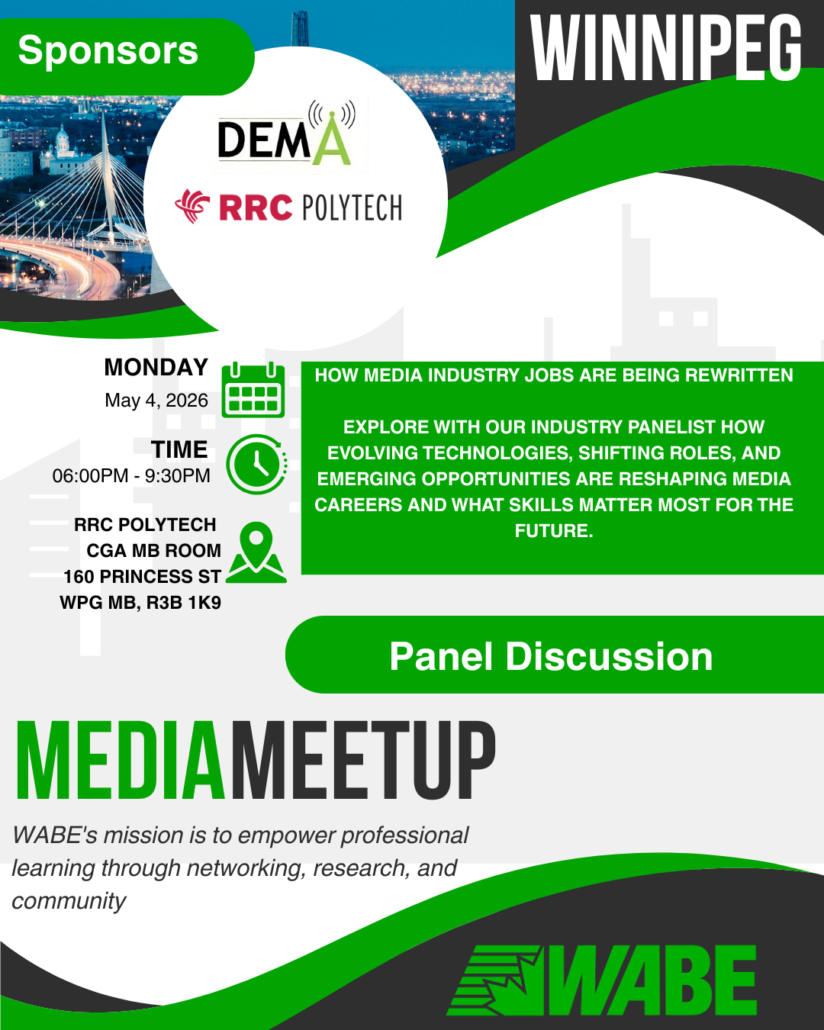
One way I am personally trying to help with this is by holding a WABE Media Meetup in Winnipeg on Monday, May 4. The goal is simple: connect students with people already working in the industry, tell students there is still an industry here, and hopefully spark interest in someone who may not have considered being part of it before. Sometimes the first step is not a job posting. Sometimes the first step is simply showing students, recent grads, and emerging professionals that media and entertainment technology is still a living, changing field full of real opportunities.
 The WABE Monday Media Meetup is being held at RRC Polytech – CGA MB, Room 160 Princess St. in Winnipeg from 6 – 9:30 p.m., with a meet and greet from 6 – 7 p.m. followed by a panel discussion from 7 – 8 p.m. titled How Media Industry Jobs Are Being Rewritten. The evening is designed for students, educators, and working professionals to hear directly from people in the field about how media jobs are changing across news, marketing, radio, television, film, live production, and event production. More content is being created than ever before, at the same time that AI and new technologies are rapidly reshaping how content is made and distributed. Traditional roles are shifting, but new opportunities are emerging every day. At the same time, a large amount of technical knowledge and production expertise is retiring out of the workforce. That creates both a challenge and a real opportunity for the next generation to step in, adapt, and help shape what comes next.
If even one student leaves that room thinking “I didn’t know this industry needed someone like me,” then that is part of the succession strategy in action.
That kind of outreach matters, but once someone enters the workforce, the next step is structured training. The probation period should not be treated as a simple test. It should be treated as structured knowledge transfer. A six- to nine-month probation is a chance to pair a junior hire with senior technical staff and expose them to as much of the operation as possible. They need to see not only the equipment, but why the business works the way it does. They need to understand signal flow, maintenance routines, troubleshooting logic, operational expectations, and how technical support intersects with service, clients, and production deadlines. That is where real succession planning happens.
It is also important to choose the right mentor, not just the most experienced one. The best trainer is not always the person with the deepest technical knowledge. Often, the best trainer is the person who is warm, patient, generous with their time, and committed to helping someone grow. A junior person who is afraid to ask questions will not learn fast enough. If mentorship matters — and it does — organizations should treat it as valuable work. That could mean more schedule flexibility, some reduction in workload, extra time off, or even a modest financial incentive. Knowledge transfer is not extra. It is business continuity.
Even when the first several months go well, employers need to stay realistic. A strong junior hire may still need another year or more before they can truly operate independently. The goal is not just to get them through probation. The goal is to get to the point where your senior engineer can go on vacation, the junior technician does not panic, and nobody is calling the cottage every day asking how to get the plant back on the air. That kind of confidence only comes with time, repetition, and exposure to real problems.
There is also a retention issue that cannot be ignored. One of the biggest risks in this process is training someone well enough that they become employable, only to lose them because you never planned a wage path. If the person succeeds through probation and begins to grow into the role, there should be a visible wage progression plan. That means showing what skills unlock the next raise, what year one, year two, and year three could look like, and being honest that while they are inexperienced today, there is a future here. No one expects a junior technician to start at the wage of someone with 25 years of broadcast engineering experience, but they do expect to see that the work will remain interesting, responsibility will increase, and stability is possible.
What matters most is that companies stop thinking only in terms of the next vacancy. If you do this right, you are not just filling a shift. You may be developing the person who stabilizes your operation through the next wave of retirements, the person who can bridge traditional baseband and modern IP systems, the person who grows alongside automation, streaming, cloud control, and hybrid production, and maybe even the person who leads your technical operation for the next decade.
The bottom line is simple. The 2025 SBE data reinforces what many in the industry already know and the answer is not to post another job ad and hope the right person appears. The answer is to start earlier, hire for aptitude, create junior pathways, intentionally transfer knowledge before retirement happens, and actively introduce students and emerging workers to the industry before they choose another path. There may not be a large pool of ready-made broadcast engineers waiting for your posting, but there are electronics graduates, networking students, computer engineering students, and hands-on problem solvers who could become excellent broadcast engineers or broadcast technicians — if the industry gives them a way in.
If you are in Winnipeg and want to be part of that conversation, the WABE Monday Media Meetup takes place Monday, May 4 from 6 – 9:30 p.m. at RRC Polytech – CGA MB, Room 160 Princess St. Registration is open here.