When a prospective vendor walked into a request-for-proposal (RFP) walkthrough at a broadcast facility, Dawna Howe laid out the project vision and clearly identified herself as the primary lead and decision-maker.
Ten minutes later, the vendor turned to her male colleague and asked who was running the project.
“When I answered him, ‘Well, that would be me, and my name is Dawn, not honey,’ he smiled and nodded,” Howe, Director of Production Technology at the Vancouver Canucks, recalled. “A few seconds later, he quietly turned around and asked my colleague that exact same question.”
Throughout the walkthrough, Howe was addressed as “honey,” “sweetheart,” and “kiddo.” The vendor, believing he was simply being warm and friendly, ending up losing out on millions in potential business.
“He didn’t get that work or the projects after that,” Howe said. “I’m not gonna pretend that that was the only factor, but it contributed. And I doubt he even knew it was a part of the equation.”
Addressing delegates at the Western Association of Broadcast Engineers (WABE) Media and Entertainment Technology Conference in Vancouver earlier this month, Howe used the experience to frame her presentation, “The Handshake Test.” While industry conferences typically focus on technological shifts, Howe emphasized that the demographic landscape and cultural expectations of broadcast and media engineering are undergoing an equally profound transformation.
“Now, that’s one man on one afternoon, and he’s really not the reason that I’m here,” said Howe. “We come to a conference like this to find out about what’s changing in our industry. Usually, we’re talking about technology. I want to highlight that the people in this industry are changing. who’s coming into it, who’s leading it, how people want to work and get to know each other. Because there’s a test running underneath every deal, every crew room, every conference bar…you’re all giving it, you’re all taking it. But do you know what’s on it? I’ve decided to call it “The Handshake Test.”
Changing demographics
Among other data cited, Howe told attendees that approximately 67% of those in senior management positions or above (the people actually making purchasing decisions) demographically are now Millennials (those born between 1981 and 1996) and Gen Z (1997-2012).
Howe said that presents an opportunity to challenge longstanding industry sales and networking norms, including relying solely on alcohol-centric events or golf outings to build client relationships. Howe cited Statistics Canada figures showing that 54% of adults and 67% of 18-to-22-year-olds reported consuming no alcohol in the previous week.
“There’s nothing wrong with the invite. There’s something wrong with it being the only one,” Howe said, noting that social events based around those traditions can quietly exclude key team members and decision-makers
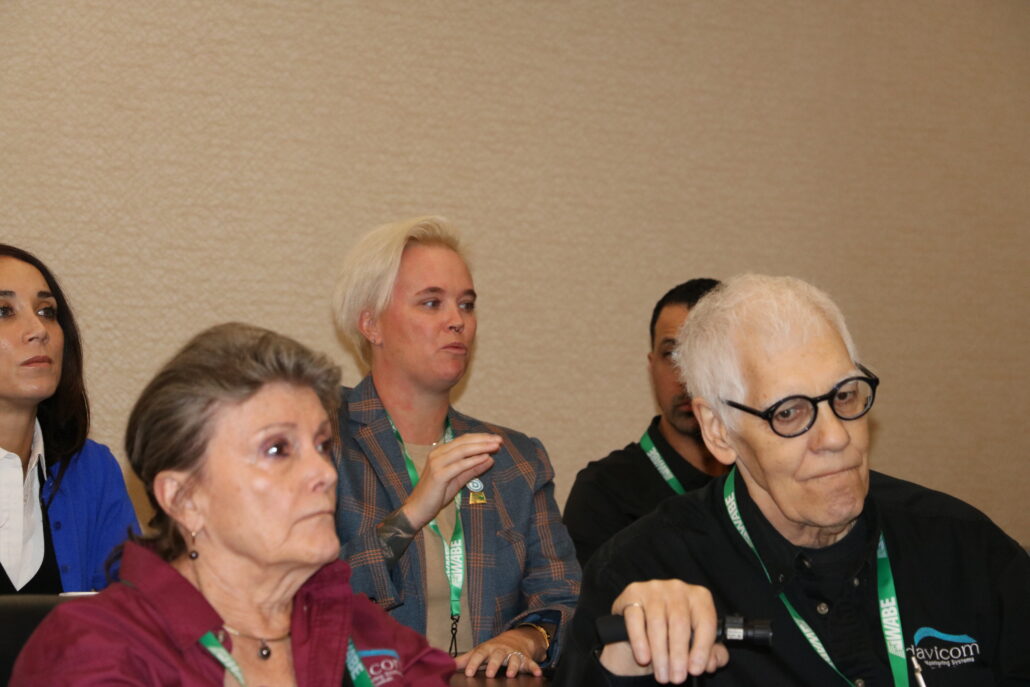 With Millennials and Gen Z increasingly filling senior management and purchasing roles across the industry, Howe said industry veterans need to update their assumptions and adapt to new working styles.
“For example…you’re waiting for a meeting to start. Someone walks up, and before you’ve been introduced, you’re already trying to work out who they are. Are they in charge? Do they know what they’re talking about? Are they worth your time? And they’re doing the exact same thing to you. Sales, integrator, venue people, we all do it. I certainly do. We know how someone looks, how they speak, who they’re standing beside, and we start filling in the things that we haven’t even learned yet. It’s our first impression. Everyone knows that, nothing wrong with that. But it can start deciding how we treat someone before we know that we’re correct. And our assumptions can dictate who we direct our questions to, whose answer we take seriously, and even who we barely speak to,” Howe said.
“So the question is, did you find out, or did you assume? Because an assumption doesn’t always feel like one…”
The three rules of ‘The Handshake Test’
Howe left the audience with three principles to navigate interpersonal dynamics in a changing industry:
-
Ask: Do not let appearance, age, or superficial familiarity dictate someone’s role or authority in the room.
-
Listen: When colleagues or clients state their roles, requirements, or boundaries, accept their answers at face value.
-
Update: Allow new facts to override initial impressions.
“Technology isn’t the only thing in this industry that’s changing,” Howe said. “The next time you’re at a walkthrough, a booth, or a site visit, your brain is gonna tell you exactly who’s in front of you, and it’s gonna feel like knowing. Treat it as a guess. Then find out.”