
Canada spent decades trying to protect its culture from the gravitational pull of American media. In podcasting, something unexpected has happened: Canadians are choosing Canadian without government intervention or incentivization.
Canada has always had a cultural trade problem.
We live next door to the largest entertainment exporter on Earth. American films fill our cinemas, American television fills our streaming services and American creators dominate many of the platforms where Canadians spend their time.
For decades, Canadian cultural policy has effectively been an attempt to push back against that gravitational pull. We created Canadian-content rules, the CBC, Telefilm, the Canada Media Fund, provincial tax credits, production incentives and broadcasting regulations.
Behind all of them aims to tackle roughly the same question: How do you make sure Canadians actually see, hear and experience Canadian stories when Hollywood is sitting next door?
Then podcasting came along and something strange happened. Canada started winning. Not in an economic sense yet, but in the increasingly important global trade in human attention. The key number:
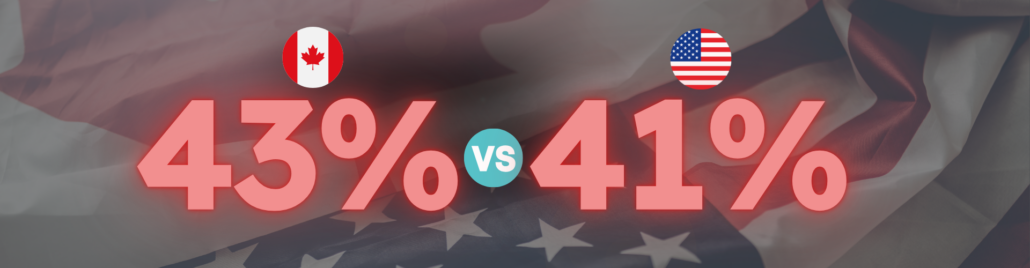
According to data from The Canadian Podcast Listener, cited in Triton Digital’s 2026 Canadian Podcast Report, Canadian-made podcasts now account for 43% of the average podcast listening time of Canadian monthly podcast consumers. American podcasts account for 41%. It is Canada’s widest lead over American podcast content in seven years. Among French-speaking Canadian listeners, the number is even more remarkable: 70% of the podcast content they consume is Canadian-made.
Think about that for a moment. Put a Canadian podcast beside an American podcast and there is no border or tariff. No Canadian-content requirement deciding what appears in your queue.
An American show is just as easy to access in Halifax, Toronto or Calgary as a Canadian one. Typically, they have bigger platforms and more money to spend on getting your attention. Yet, despite the David and Goliath battle for your time, Canadians are choosing Canadian.
In cultural terms, that’s a pretty big deal. Particularly when you compare it with some of the industries Canada has spent decades trying to protect.
Canadian films accounted for just 1.7% of the domestic theatrical box office in 2025, down from 2.8% the previous year. Those aren’t directly comparable measurements, one is listening time and the other is box-office revenue, but culturally the contrast is hard to ignore.
Canadian podcasting appears to have achieved something we’ve historically found extremely difficult: getting Canadians to voluntarily choose Canadian popular culture in an open market.
And hardly anyone seems to be talking about it.
The strange economics of podcasting
Part of the reason is that podcasting still looks tiny when we measure it using traditional economic statistics. Canadian podcast advertising generated $98.8 million in 2024, while Canada’s overall internet advertising market was worth $18.2 billion.
Social media alone attracted $5.4 billion in advertising. Then compare podcasting with the screen industries, Canadian film and television production generated approximately $10.2 billion in production volume in 2024/25, contributed around $12 billion to GDP, and supported more than 181,000 jobs.
On paper, there isn’t even a competition. Film and TV: billions vs Podcasting: $98.8 million. Let’s pack up and go home on this metric alone.
Except we’re measuring completely different things. That $10-billion screen number attempts to describe an industry, the $98.8-million podcast number mostly describes an advertising category. And those aren’t remotely the same thing.
Imagine measuring film the way we measure podcasts
Suppose we decided that the economic value of Canadian television was simply the amount of advertising sold against Canadian television programmes. We’d immediately miss production crews, studios, actors, writers, equipment rentals, post-production facilities, distributors, broadcasters, streaming revenues, exports and hundreds of other businesses.
Nobody would accept that as a serious measurement of the television industry, yet we routinely do something similar with podcasting.
Podcast advertising revenue doesn’t capture the full economic activity generated by podcast production companies, studios, freelance editors, hosts, journalists, video crews, designers, composers, subscriptions, memberships, Patreon, branded podcasts, corporate production, live shows, consulting, IP development or direct sponsorship agreements.
And increasingly, it doesn’t even capture the whole podcast, because what exactly is a podcast anymore?
- Record two people talking for an hour, put the audio on Apple Podcasts and Spotify: podcasting.
- Put exactly the same conversation on YouTube: suddenly you’re in the creator economy.
- Cut six clips for TikTok and Instagram: social content.
- Sell tickets to watch them record it: live entertainment. Sell the format internationally: intellectual property.
Same creators, same production, same audience relationship: Different economic boxes.
No wonder the numbers are messy.
Meanwhile, the creators got themselves an industry
The comparison with the broader creator economy is particularly revealing.
The Canada Media Fund has estimated that Canada’s digital creator ecosystem could contribute somewhere between $2.58 billion and $4.3 billion to GDP, supporting a wider ecosystem of roughly 45,000 to 75,000 full-time-equivalent jobs. The CMF itself is careful to acknowledge the difficulties in making that calculation. There still isn’t a perfect definition of what a digital creator actually is.
YouTube has gone further. Oxford Economics estimates commissioned by YouTube found that the platform’s creative ecosystem contributed more than $2 billion to Canadian GDP in 2025 and supported more than 35,000 full-time-equivalent jobs.
Again, podcasting sits awkwardly inside these numbers. This isn’t a criticism of the research, it’s evidence that our definitions haven’t caught up with the medium.
But forget money for a minute
There’s another currency in media that may ultimately matter more: Attention.
And that’s where podcasting becomes much harder to dismiss. In 2026, 46% of Canadian adults consume podcasts every month, up from 39% in 2024. Triton describes it as the largest single-year increase ever recorded for podcast consumption in Canada. Weekly podcast listeners consume an average of 4.1 different podcasts and 8.9 episodes.
Almost half the adult population is now participating in the medium every month. That’s mass media, but podcast attention is also unusual. A social impression might last a second, TikTok might hold somebody for 20 seconds, YouTube videos might get five or 10 minutes.
A podcast routinely asks someone to spend 30, 45 or 60 minutes with the same voices. Then come back next week, and the week after that and that’s an incredibly deep unit of attention. And from a cultural perspective, who gets that attention matters.
This is where the trade war gets interesting
Hollywood doesn’t simply export movies, it exports language, fashion, politics, humour, values, celebrities, places, brands and ideas. American culture has become one of America’s most successful exports precisely because consuming it rarely feels like importing anything.
Which makes podcasting’s 43% Canadian share interesting in a completely different way. For perhaps one of the first times in the modern digital era, Canadians aren’t simply consuming a platform filled overwhelmingly with foreign cultural products. They’re using global platforms to consume homegrown, Canadian-centric products.

So maybe Canada’s podcast problem isn’t an audience problem, its economic.
The conversation around Canadian podcasting often focuses on scale. Canada is too small, there aren’t enough listeners, CPMs aren’t high enough, advertising budgets aren’t big enough. But 46% monthly reach and a 43% share of listening for Canadian-made content suggest demand isn’t really the fundamental problem.
Canadians are already listening, they’re already choosing Canadian. The missing piece may be our ability to turn that attention into a sustainable domestic industry. That’s an advertising problem, a funding problem, a measurement problem, an export problem and perhaps an industrial-policy problem.
We’ve built the audience. Now build the economy.
Canada understands how to talk about film and television as industries. We can calculate their production volume, their GDP contribution, their labour impact, exports and tax incentives. We can tell governments that Canada’s film and television production sector supports 181,360 jobs because somebody has actually built the methodology required to count them.
Podcasting doesn’t yet have an equivalent, so we reach for the number we do have – $98.8 million in advertising. And then wonder why podcasting looks small.
Perhaps the more useful project would be to measure the entire Canadian podcast economy: production spending, employment, independent creators, production agencies, public broadcasters, subscriptions, memberships, branded content, advertising, video, live events, exports, technology and IP.
Then measure the attention generated by that spending. If we did, my suspicion is that podcasting would start looking considerably more interesting.
The quiet Canadian cultural success story

There are some certainties, film and television will remain enormously important Canadian industries, the creator economy will continue to expand and social video will consume huge quantities of attention.
Podcasting doesn’t need to replace any of them, but it deserves to be understood on its own terms. Especially by legislators, regulators, funders and those who make it their business to nurture Canadian culture.Because something genuinely unusual, amazing and exciting has happened here. Canada has spent generations worrying about whether its stories can survive next to America’s.
Podcasting has effectively done something totally new, when everything on the same device, most of the barriers are gone and the consumers almost unlimited choice: Canadians chose Canadian podcasts.
Now the challenge is figuring out what that choice is worth, because Canada may already be winning the podcast war for attention. We just haven’t figured out how to cash in the victory.