For decades, broadcast networks were built primarily to deliver linear television from high-power central transmission sites. In today’s landscape, we are seeing a shift toward more data-centric broadcast infrastructure, with ATSC 3.0 allowing broadcasters to carry IP-based data alongside traditional programming. Navigating this transition will require careful investment in RF systems capable of reliably supporting both current operations and future applications. Dielectric, a pioneer in broadcast innovation since 1942, believes selecting the right RF partner will be critical to this data-centric future.
“Today, U.S. broadcasters are caught between their traditional retransmission revenues and what they may be able to do in the future with ATSC 3.0 and more data-centric services,” said Keith Pelletier, President of Dielectric. “The question is: what do they do next? What data-centric services can they provide and how do they support future generations of users?”
Turning that potential into a viable service will depend on more than the data itself. Broadcasters will need RF infrastructure capable of delivering reliable signals across the markets, devices and applications they intend to benefit. That is likely to increase the importance of Single Frequency Networks (SFNs), which combine a main transmitter with several lower-power sites operating on the same frequency to improve signal density and coverage.
“Broadcasters will need to saturate major markets with a stronger signal, ensuring people can receive services on handhelds, computers and whatever devices they use in the future,” Pelletier continued.
However, the effectiveness of an SFN depends on how closely it is designed around the individual market. Tower locations, terrain, coverage requirements, signal patterns and engineering constraints can vary considerably, making a standardized, or ‘cookie-cutter’ design inherently limiting.
“A cookie-cutter approach requires you to make a lot of assumptions that are unlikely to apply to every network,” explained Pelletier. “A broadcaster in Calgary will have drastically different outlying tower sites compared to a broadcaster in Halifax. If you’re applying the same RF solution, you are relying on the broadcaster accepting that its coverage area might not be fully optimized.”
Dielectric recognizes the need to treat each market as a distinct engineering project, with design based on the broadcaster’s objectives rather than implementing a predetermined configuration.
“We look at where the broadcaster is trying to reach and design for that specific market parameters rather than offering something that is merely close,” Pelletier stated. “It requires more upfront engineering and, in most cases, the creation of specific antenna systems. But at the end of the day, the customer gets an optimal system rather than a compromise.”
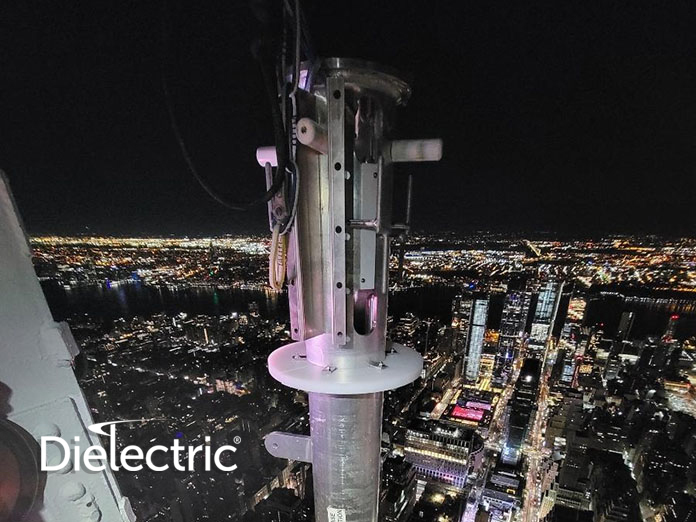
Beginning with a detailed assessment of each site and its individual requirements, Dielectric uses tools including Google Maps, coverage modeling and HFSS electromagnetic simulation, alongside analysis of system gain and loss, bandwidth and VSWR, to identify and address potential engineering challenges.
“Whether the system is supporting analog television, digital television or ATSC 3.0, we are designing around many of the same fundamentals, sometimes for slightly different reasons,” said Pelletier.
That engineering focus continues after deployment. Dielectric’s real-time, IP-connected monitoring system, RFHAWKEYE, enables TV and radio broadcasters to track the health of transmission lines and antennas for quick troubleshooting in the event of failures or disruptions.
“It allows us to identify developing problems before they cause costly failures or service disruption.”
Beyond its site-specific engineering and ongoing system support, Dielectric is also backed by experience across major broadcast transitions, including the move to digital television, Qualcomm’s FLO mobile television initiative, large-scale deployments in Mexico and the U.S. spectrum repack. The repack was a particularly significant test, requiring Dielectric to develop and deliver new solutions across the market within approximately two and a half years.
“We maintained a site-specific engineering mindset throughout, all while scaling our engineering, manufacturing, supply chain, and wider partner network to meet the unique demands of an industry-wide deployment program,” recalled Pelletier. “As SFNs and more data-centric services move to the forefront, we have already shown that we can support that scale.”
For broadcasters evaluating future RF investments, Pelletier believes the key questions should centre on engineering depth, proven deployment experience, scalable processes, and long-term support.
“The broadcaster should look at the partner’s talent depth and its track record,” he concluded. “What has that company delivered in the past that demonstrates it can support the broadcaster moving forward?”
As broadcasting moves beyond linear television, the strongest RF partner will not simply supply equipment. It will translate data-centric ambitions into reliable, market-specific infrastructure. Dielectric’s experience across multiple technology transitions, combined with its site-specific engineering expertise and ability to deliver at scale, positions it to support broadcasters as they move toward a more data-centric future. In preparation for this deployment, Dielectric has been advancing its SFN portfolio since 2016, continuously expanding and refining its design capabilities. This sustained investment and experience have positioned Dielectric well to support the next major rollout of these emerging services.
Dielectric president Keith Pelletier rejoins Shawn Smith to talk about how broadcast TV is becoming an IP-based data service, and what it takes to build the infrastructure behind it. Keith explains how ATSC 3.0, and Brazil’s version of it, DTV+, open new revenue streams for broadcasters: targeted advertising, datacasting, mobile TV, advanced emergency alerting and more. He also walks through the TV Globo rollouts in São Paulo and Rio de Janeiro, which went from order to shipment in about three months to make the FIFA World Cup deadline.